
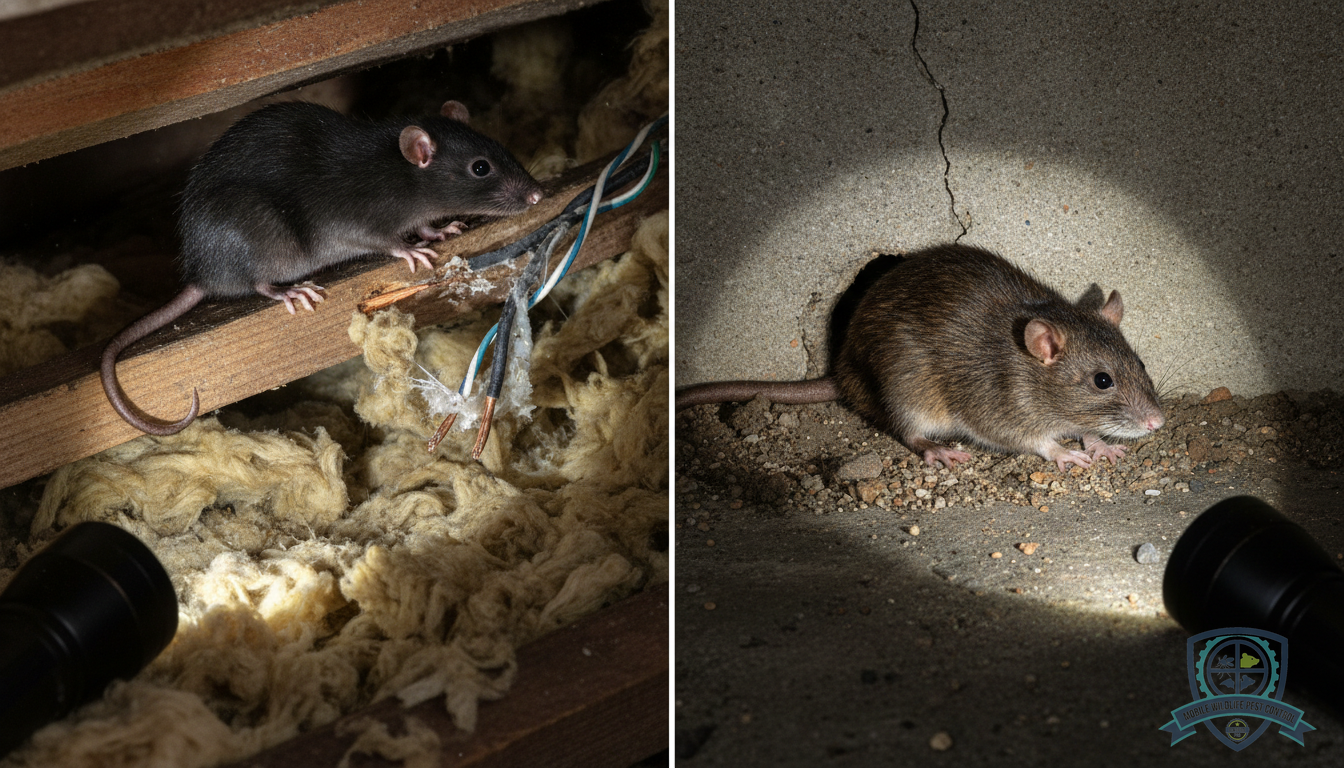
Why Mobile, AL Has Such a Persistent Rodent Problem
Mobile's mild winters, dense urban tree canopy, older housing stock, and proximity to waterways create nearly ideal conditions for rodent populations to thrive year-round. Unlike northern cities where harsh winters temporarily suppress rodent activity, Mobile homeowners can encounter rats and mice in every season. Neighborhoods like Whistler, Toulminville, and Prichard — where older homes with aging foundations and overhanging trees are common — tend to see the highest rodent call volumes.
The two species our technicians encounter most frequently are the roof rat and the Norway rat. These animals behave differently, nest in different locations, and respond best to different control strategies. Misidentifying the species you're dealing with is one of the most common reasons DIY rodent control fails.
Roof Rats: The Acrobatic Attic Invader
The roof rat (Rattus rattus) — also called the black rat or ship rat — is the dominant species in most Mobile residential neighborhoods. These animals are excellent climbers that use tree branches, utility lines, and roof eaves as highways into your home. Their preferred nesting sites are elevated: attics, soffits, wall voids near the roofline, and false ceilings above drop-tile areas in commercial buildings.
How to identify roof rat activity in your Mobile home:
- Droppings about ½ inch long, spindle-shaped with pointed ends, found along rafters or attic insulation
- Greasy rub marks (sebum trails) along attic beams and the tops of wall plates
- Gnaw marks on wood framing, electrical wiring, and HVAC ductwork in the upper portion of the structure
- Scratching or running sounds in the ceiling at night — roof rats are nocturnal and most active shortly after sunset
- Nests built from shredded insulation, paper, and plant material tucked into attic corners
Roof rats are notoriously neophobic — they avoid new objects in familiar territory, which is why a trap placed carelessly in an attic often sits untouched for weeks. Professional placement using established rodent runways and appropriate baiting dramatically improves trap success.
Norway Rats: The Burrowing Basement and Foundation Pest
Norway rats (Rattus norvegicus), also called sewer rats or brown rats, are larger and stockier than roof rats and prefer to live at or below ground level. In Mobile, they commonly burrow under concrete slabs, along foundation walls, inside crawl spaces, and beneath exterior structures like sheds, decks, and dumpster pads. They are strong swimmers and frequently follow storm drain systems, which is why they appear more commonly in neighborhoods near drainage canals and low-lying areas like Chickasaw.
How to identify Norway rat activity:
- Burrow entrances 2–3 inches in diameter with smooth, compacted openings along foundation edges or beneath concrete
- Droppings approximately ¾ inch long, blunt on both ends, found near ground-level areas like kitchen baseboards or utility rooms
- Gnaw marks on low-level structures, plastic pipe insulation, and food packaging in pantries or garages
- Grease marks along lower walls and floor edges where the rats travel repeatedly
- Damaged insulation and vapor barrier material in crawl spaces
Why DIY Rodent Control Rarely Works Long-Term
Store-bought snap traps and bait blocks are widely available and can certainly catch individual rodents. The problem is that they address the symptom — the rodent you can see or hear — without addressing the root cause: the entry points, harborage conditions, and food sources that are drawing rodents to your home in the first place.
A single female Norway rat can produce four to six litters of six to twelve pups per year. Roof rats produce three to five litters annually. If exterior entry points remain open and population pressure from the surrounding environment continues, trapping inside the structure becomes an endless cycle rather than a permanent solution. Professional rodent control addresses all three elements simultaneously: elimination of the existing population, exclusion of all entry points, and modification of conditions that attract rodents.
The Mobile Wildlife Pest Control Rodent Elimination Process
When you call us for rodent control at your Mobile home, here's what our process looks like:
- Full exterior inspection: We walk the entire roofline, soffit, foundation perimeter, utility penetrations, vents, and garage door seals to identify every opening ¼ inch or larger — the minimum size a mouse needs to squeeze through, and roughly ½ inch for a juvenile rat.
- Interior inspection: We access the attic and crawl space to document nesting sites, gnaw damage, droppings, and active runways, which guides trap placement strategy.
- Mechanical trapping: Snap traps are placed along confirmed rodent runways inside the structure. Our technicians return on scheduled follow-up visits to collect and reset traps until catch counts reach zero.
- Exclusion repairs: Accessible gaps are sealed using steel wool, hardware cloth, copper mesh, and expanding foam — materials rodents cannot chew through easily. More involved structural repairs may require a licensed contractor, and we'll advise accordingly.
- Exterior bait stations: Tamper-resistant bait station boxes are installed along fence lines, garage perimeters, and other high-pressure zones to intercept new rodents before they find a way inside.
After population knockdown is confirmed, we provide guidance on attic remediation — addressing gnawed wiring, soiled insulation, and sanitation issues left behind by rodent activity. For homeowners dealing with both rodent and wildlife pressure, ask about combining our rodent service with our wildlife removal program for comprehensive critter protection.
Preventing Re-Infestation: What Homeowners Can Do
Even after a successful treatment, ongoing vigilance matters. Here are habits that help Mobile homeowners stay rodent-free between professional visits:
- Keep tree branches trimmed at least four feet away from the roofline — this is the primary access highway for roof rats in Mobile's heavily wooded neighborhoods like Spring Hill
- Store firewood at least 18 inches off the ground and away from the house exterior
- Use metal or heavy plastic bins with locking lids for garbage and compost
- Address any water leaks, condensation, or drainage issues that create moisture in crawl spaces and basements
- Inspect weather stripping around doors and garage seals at least once per year
- Schedule professional rodent inspections annually — or twice yearly if you've had prior activity
Book Your Rodent Inspection in Mobile, AL
Mobile Wildlife Pest Control provides professional rodent control services to residential and commercial properties throughout Mobile and surrounding areas including Midtown Mobile, Prichard, and Whistler. We're available Monday through Sunday from 8:00 AM to 6:00 PM. Call us at +1 (251) 292-8884 or email [email protected] to schedule your inspection today.
Discuss This With Our Team
Call +12512928884 or fill out our online form for a free, no-obligation quote.
Request Free Quote